
There’s a common saying: a tourist doesn’t know where they have been, and a traveller doesn’t know where they are going. I try my best to associate myself with the latter group.
“Traveling is living in a foreign place. … As in, experiencing all four seasons of normal life in a foreign place. Leaving behind a home environment where one’s habits have settled into old, tired ways and spending one’s days somewhere else, trying to find some new feeling in the mere act of being alive in the world. In this sense, traveling is a way of cleansing one’s body and mind – starting afresh.” (Yang Shuang-Zi, Taiwan Travelogue).
I’m an avid walker, and when visiting new communities, I enjoy purposely getting lost in my attempt to explore and discover something different, always with safety in mind, of course. I’ll select an area I want to explore, and once I reach my starting point, I’ll bury my phone in my pocket after enabling the tracker app. I’ll have a general sense of my final destination. It’s always amusing to see how terribly unsuccessful my mental compass may be in reaching my destination. The tracker allows me to revisit my path, which helps me understand where I went and possible course corrections.
And Tokyo is a great place to get utterly lost. Tokyo’s street pattern is often described as a “weave” because it is not a single, orderly grid. It is a patchwork of broad avenues, railway corridors, old village lanes, tiny alleys, and irregular blocks. The postwar return of residents helped reinforce that pattern. And there are no street signs or clear indicators to help determine your location.
Tokyo suffered extensive firebombing in 1945. Many neighbourhoods were burned, and large numbers of residents were evacuated or displaced. After the war, people gradually returned to rebuild homes and businesses, often on or near the land their families had occupied before the bombing.
In many areas, landownership was fragmented: plots were small, irregular, and divided among numerous owners. Where land readjustment or comprehensive redevelopment did not take place, people commonly rebuilt on their existing plots. That preserved old property boundaries and produced winding, narrow streets rather than a uniform street plan.
At the same time, postwar Tokyo faced severe housing shortages and rapid population growth. Homes and shops were built quickly, sometimes incrementally, along whatever paths and access lanes were available. Railway stations and commuter lines drew intense development, encouraging dense clusters of businesses and housing around them. It would be too simple to say that returning Tokyoites alone made the streets confusing: the city’s irregular pattern developed over centuries, and postwar rebuilding often preserved or intensified it.
Now that my house is in good order and I’ve established a daily routine, it was time for a long walk, targeting ten kilometres. I live in Kasuga in Bunkyo-ku, four kilometres northeast of Tokyo Station, in a highly compact residential area. My goal was to reach Ueno Koen, a popular park and tourist destination housing the Tokyo National Museum, Tokyo Metropolitan Art Museum, The National Museum of Western Art, National Museum of Nature and Science, and the Ueno Zoological Gardens (once a destination to see the twin pandas, Xiao Xiao and Lei Lei, now returned to China).
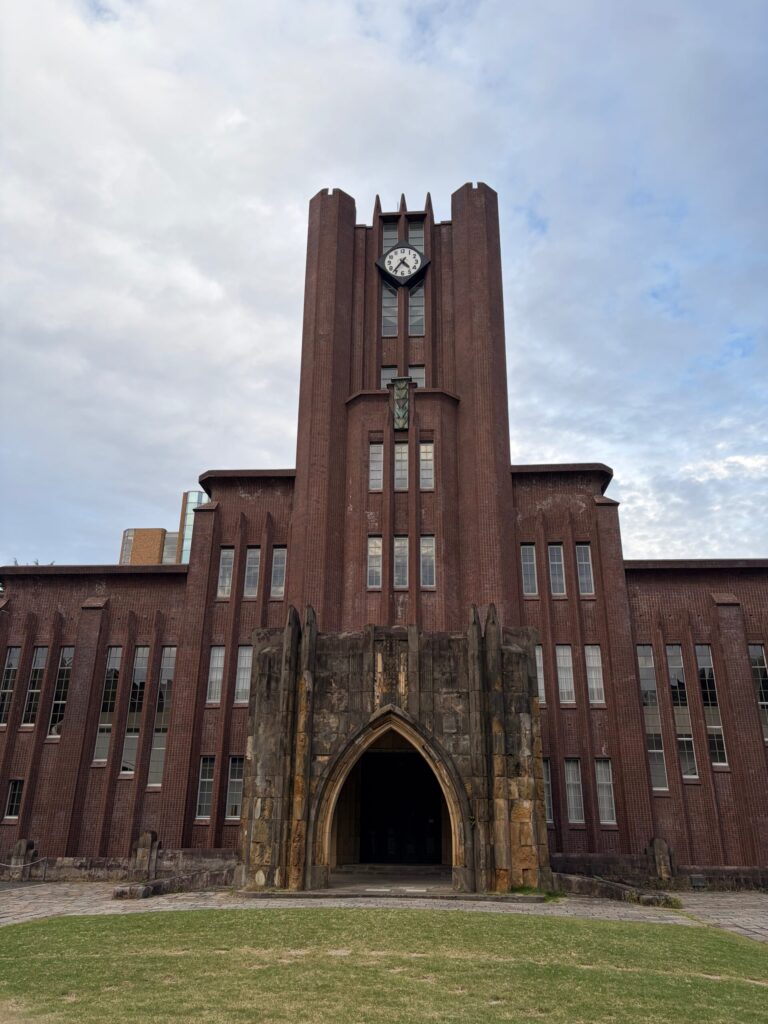
The University of Tokyo, considered one of the two top universities in Japan to its rival, Kyoto University. It’s wedged between home and Ueno Koen, so I planned to meander around its massive campus to enjoy the eclectic architecture.
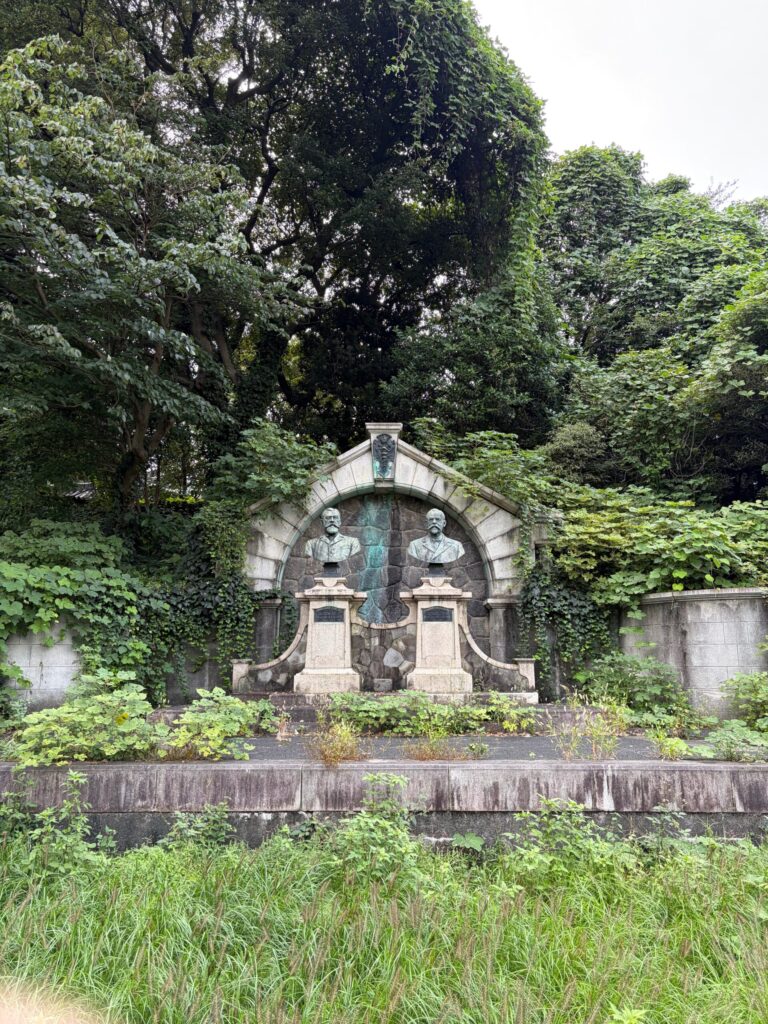
The University is well worth a visit. It’s surprisingly quiet for a university campus, spacious, and a green oasis surrounded by the dense concrete jungle of Tokyo. The grounds are completely unmanicured, making it look unruly, dishevelled, and giving it an appearance of abandonment. I’m not sure if this is by intent or for a lack of budget for maintenance.
The University of Tokyo’s main Hongo campus is best described as a blend of historic European-inspired architecture and modern Japanese university design.
Its older buildings often reflect Western academic styles introduced during Japan’s modernization in the late 19th and early 20th centuries—including brick or stone façades, symmetrical layouts, arched windows, and formal entrances. The most recognizable example is the Akamon (“Red Gate”), an early-19th-century gate built in a traditional Japanese style for the Maeda clan’s Edo residence, which predates the university.
The General Library was built in Showa 3 (1928) after the original library was destroyed in the Great Kanto Earthquake of September 1st, Taisho 12 (1923), and the 700,000 books it held went up in flames. Interestingly, the reconstruction of the General Library was carried out with a donation from John Rockefeller Jr.
Tokyo’s maze-like streets and layered architecture reveal a city repeatedly rebuilt without ever quite erasing what came before. But walking past the university’s untamed grounds also left me wondering about a different kind of urban landscape: homes that stand empty while people and buildings press tightly together. In part two, I’ll explore Tokyo’s abandoned-housing crisis—and what these vacant homes say about the city’s future.