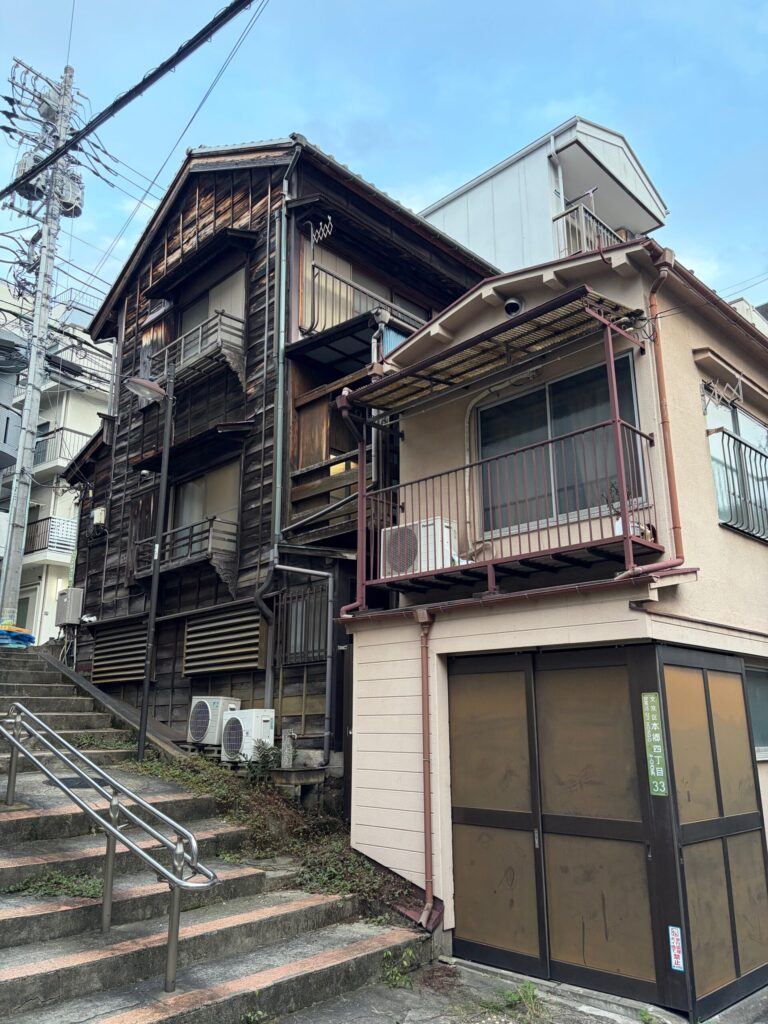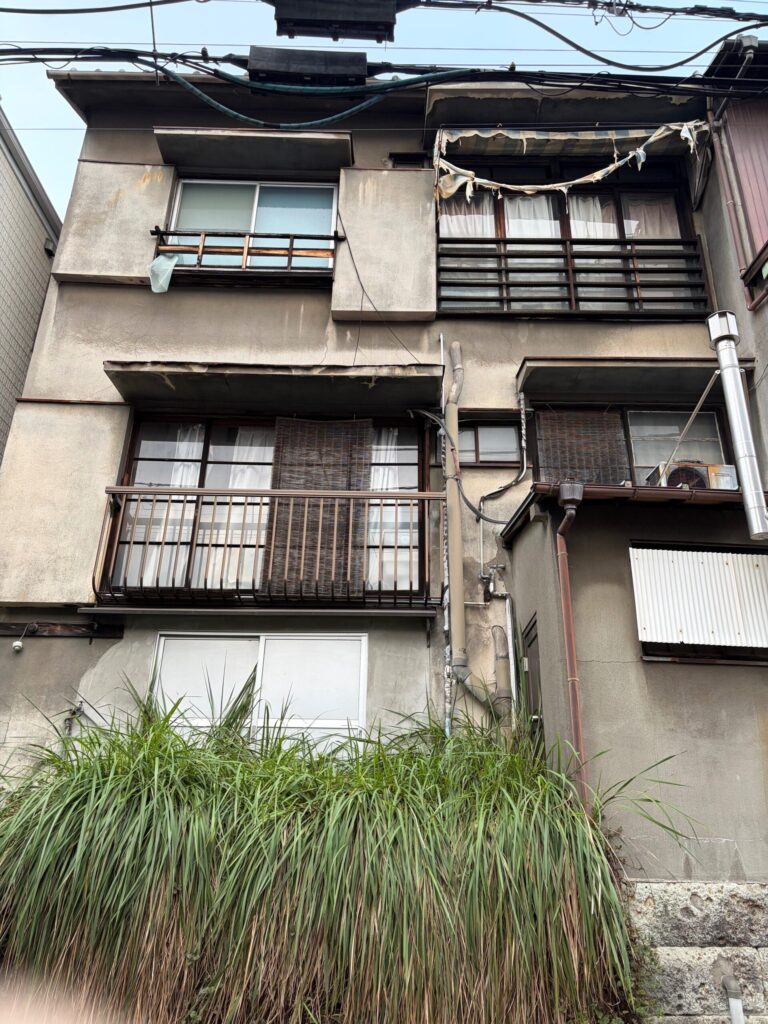
If you ever find your way into the narrow residential streets of Tokyo, without question, you will stumble across a recent phenomenon in Japan, “Akiya.” This term refers to the growing phenomenon of vacant or abandoned houses across Japan. Driven by a shrinking and aging population, rapid urbanization, and complex inheritance laws, this issue has become a significant national challenge.
They often appear in the most unexpected locations, in close proximity to spanking new and glittery high-rise buildings or next to a recently constructed house. They’re easily identifiable by the missing resident’s nameplate at the front of the house and by the overall unkept look and decay of the overall structure. I can’t imagine living next door to one, likely impacting the value of neighbouring homes and the fire hazard they present to the community where houses are spaced only an arm’s length away. They are often old, dilapidated wooden structures in very close proximity to neighbouring houses.
For years, I have been photographing these houses in Tokyo, and they can be found in absolutely every neighbourhood. I find they hold a nostalgic appeal, architecturally reflective of a time bygone and often quite beautifully traditional in design. Their wooden structure and edifice have an aged and warm patina. So it’s saddening to think of what may have become of their occupants and why they don’t easily change hands to new homeowners in a city where single-dwelling ownership is for the financially privileged.
The scale of the crisis is astonishing. According to data from the Ministry of Internal Affairs and Communications, the number of vacant homes in Japan has reached record levels. As of the 2023 survey, there were approximately 9 million vacant homes in Japan (includes abandoned and unoccupied houses), representing roughly 14% of the nation’s total housing stock. This figure has shown a consistent upward trend. The number of akiya has effectively doubled since the early 1990s.
Simply put, Japan has a vacancy crisis. While the crisis is most severe in rural areas facing depopulation, Tokyo is not immune. Even within a dense metropolis, individual properties—often inherited by family members living elsewhere—fall into neglect, contributing to the city’s complex urban landscape. Based on the same 2023 survey data, Tokyo’s vacancy rate is typically reported as about 10% (nearly 900,000 houses), reflecting the continued high demand for housing in the capital compared to more rural or depopulating areas of Japan.
These houses often do not appeal to a younger generation – generally small, lacking highly automated functions, more expensive to renovate than to rebuild, and a shift in today’s desirable aesthetics, floor plans, and design. Updated bylaws can also present challenges that prohibit rebuilding.
Inheritance issues can turn a family home into a property that nobody can readily use, sell, or maintain. The result is not that inheritance law automatically creates vacant houses, but that unclear ownership, multiple decision-makers, and costs can make an already unwanted property harder to resolve. Meanwhile, maintenance, taxes, and demolition costs can make the home a burden, so families may leave it vacant.
The Japanese government and local municipalities have implemented several strategies to mitigate the risks associated with akiya. A Special Measures Act on Vacant Houses (2015) legislation granted local authorities greater power to intervene. It allows mayors to identify neglected, dangerous properties, order owners to take corrective measures (such as repair or demolition), and if those orders are ignored, to perform the work themselves at the owner’s expense.
Many local governments have established “Akiya Banks” – online databases and registries that list vacant homes for sale or rent, often at very low, subsidized, or even free prices, to encourage new residents (particularly young families or telecommuters) to revitalize these properties.
Most intriguing are the community-based organizations taking efforts to include creating financial frameworks to provide loans to businesses that renovate vacant houses, transforming them into affordable housing or community spaces.
With all of these measures in place, the long-term outlook suggests this pressure will continue. Japan’s population is projected to fall substantially over coming decades, while the share of older people remains high. Japan’s total population peaked in 2008 and is projected to drop to approximately 87 million by 2070, which would represent a decline of roughly 30% from its peak. By 2070, it is estimated that the population aged 65 and over will make up approximately 40% of the total population.
That means more homes may be left behind even as demand weakens—especially in places already losing residents. Inherited properties can be difficult to sell or maintain when ownership is unclear, several heirs must agree, or repair and demolition costs are high. These factors can turn temporary vacancy into long-term abandonment.
Government programs—including Akiya Banks, renovation support, and rules that allow action on neglected properties—can help, but they cannot by themselves reverse the demographic trend. Without stronger measures to clarify ownership, make reuse or demolition easier, and align housing supply with future demand, Japan’s vacant-home problem is likely to grow and become more concentrated in depopulating communities.
Japan’s depopulation crisis is too often overlooked and inadequately addressed. Unless it is tackled more effectively, I expect to see more and more akiya on my walks around Tokyo.